MiniHack
MiniHack is a powerful sandbox framework built on top of the NLE that enables researchers to easily design rich and diverse environments for RL. It provides a flexible platform for creating custom RL tasks ranging from simple grid-world navigation to complex, procedurally generated worlds with intricate game mechanics. The framework allows users to define environments using a human-readable description language or a simple Python interface, giving fine-grained control over environment elements such as terrain, objects, monsters, and traps. MiniHack offers a diverse array of tasks, which can be broadly categorized into three main groups: Navigation Tasks, Skill Acquisition Tasks, and Ported Tasks. To enable interaction with language models, we use the NetHack Language Wrapper.
From the MiniHack Navigation Tasks, we picked Corridor and CorridorBattle, which challenge the agent to reach the goal position by overcoming various difficulties on their way, such as fighting monsters in corridors and navigating through complex or procedurally generated mazes. These tasks feature a relatively small action space, i.e., movement towards 8 compass directions, and based on the environment, search, kick, open, and eat actions.
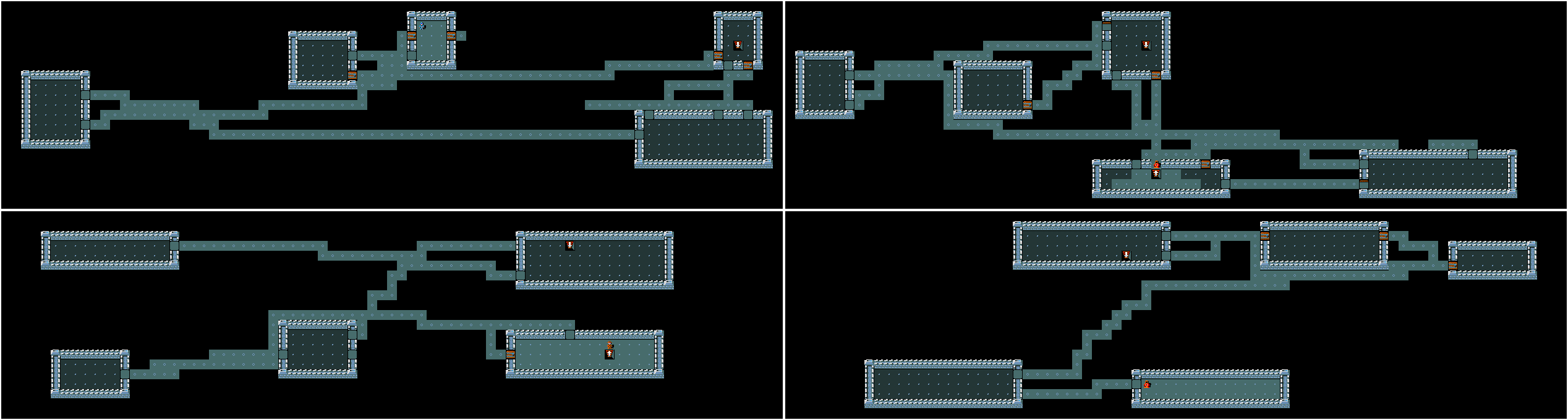

From the MiniHack Skill Acquisition Tasks, we picked Quest (with three different difficulty levels, Easy, Medium, and Hard), which challenges the agent to use objects found in the environment to cross a lava river (these objects can provide levitation or freezing abilities), fight monsters, navigate through rooms or mazes and towards the end of the quest use a wand of death to defeat a powerful monster guarding the goal location.

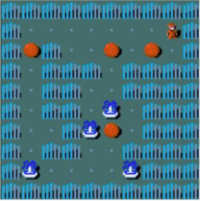
We additionally test the agents on MiniHack Boxoban. This family of environments is an adaptation of the Boxoban puzzle game, which itself is inspired by the classic Sokoban. These environments present a challenging puzzle-solving task within the MiniHack framework, leveraging the NetHack game mechanics. The primary goal in MiniHack Boxoban is to push four boulders (MiniHack’s equivalent of boxes) onto four designated goal locations, which are represented by fountains. This task requires strategic thinking and planning, as the agent must carefully maneuver the boulders through the environment without getting them stuck in corners or against walls.
Standard errors were computed using 5 seeds for each task. Here, GPT-4o and a Gemini-1.5-Pro equal each other both in language-only and vision-language mode, with both models only managing to complete some of the corridor and corridor battle tasks. None of the other models solved any task.
LLM results
Model |
Average Progress (%) |
|---|---|
gpt-4o |
5.71 ± 3.92 |
gemini-1.5-pro |
5.71 ± 3.92 |
gpt-4o-mini |
0.00 ± 0.00 |
gemini-1.5-flash |
0.00 ± 0.00 |
llama-3.1-70B-it |
0.00 ± 0.00 |
llama-3.2-11B-it |
0.00 ± 0.00 |
llama-3.2-90B-it |
0.00 ± 0.00 |
VLM results
Model |
Average Progress (%) |
|---|---|
gpt-4o |
5.71 ± 3.92 |
gemini-1.5-pro |
5.71 ± 3.92 |
gpt-4o-mini |
0.00 ± 0.00 |
gemini-1.5-flash |
0.00 ± 0.00 |
llama-3.2-11B-it |
0.00 ± 0.00 |
llama-3.2-90B-it |
0.00 ± 0.00 |
Observations
TODO